Click HERE for PDF version.
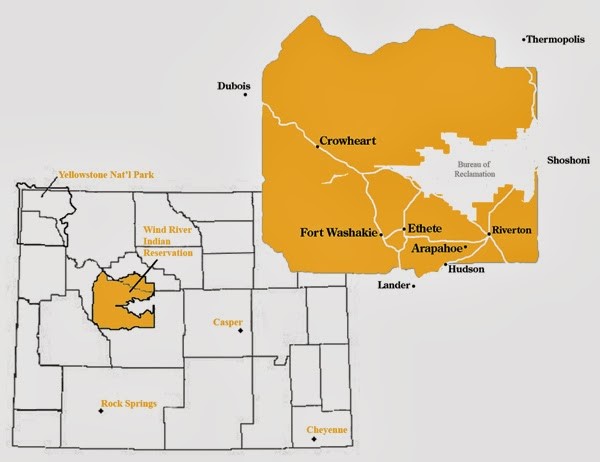
The Wind River Reservation spans 2.5 million acres, with a population of approximately 25,000. Across the reservation, there are approximately 80 unelectrified households. Some of these households might have unreliable access to power sources. Their neighbors may be kind enough to let them run an extension cord from their house to power small appliances. Some might have a costly emergency generator that’s used when electricity is needed. Some choose to live disconnected from the energy grid and separate from others. However, most of these homes have no access to electricity whatsoever. At least one unelectrified household was unable to live in their home year-round. In the winter, when temperatures stay well below freezing, they would have to find a relative or friend to stay with. In another home, an Elder had his power turned off by the utility over an $11 overdue bill sent while he was out of town. A freezer full of meat was ruined, and he chose to live without electricity for years as a result.
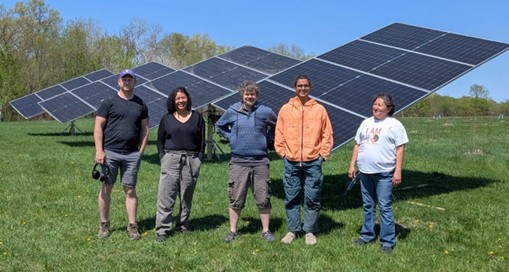
This is no longer the case, as now these homes are electrified and powered by solar panels installed by Energize Wind River. This newer organization is making it easier than ever before to overcome the challenge of a lack of electricity.
Establishing Energize Wind River
Energize Wind River (EWR) was established through a collaborative effort between the Eastern Shoshone Housing Authority and the Wyoming Energy Co-Op with authorization from the Eastern Shoshone Business Council to serve the Tribal Citizens of the Wind River Reservation living in unelectrified homes or facing unreasonably high electricity burdens. They are also doing so with solar panels and batteries, which creates opportunities for homes to disconnect from the larger electricity grid. This allows community members to potentially eliminate their electricity bills and increases Tribal energy sovereignty in the region by localizing energy generation. EWR is accomplishing this with a local Indigenous workforce.
“Our mission is bringing clean electricity to the Wind River Reservation by harnessing the power of the sun. Join us in creating a brighter future for our community through solar installations and electrification programs.” – Energize Wind River’s Mission and Vision
Established in 2024 EWR, a 638 contracted community solar project operating as a non-profit, was developed through public feedback and informational meetings, ensuring that they are directly responding to the wants and needs of the Wind River community. This process was guided by Justice40, a Biden-administration initiative aiming to have 40% of the overall benefits from certain Federal climate, clean energy, and other investments flow to disadvantaged and marginalized communities. Part of the Justice40 initiative was to document the asks of the community and how those asks will be incorporated in a project to strengthen grant applications, which EWR did through community meetings and information sessions.
On-the-Job Training
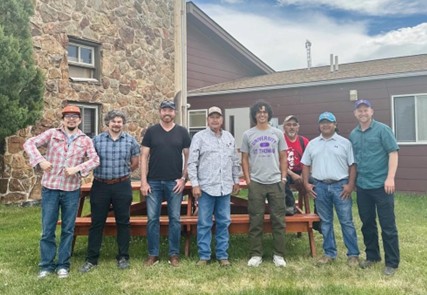
Starting with just 1 employee in 2024, EWR has grown to 8 staff members and is hoping to hire a 9th member soon. All but one staff member are enrolled Tribal citizens. While the initial focus of EWR was solar panel installation and electrification of Tribal homes, their scope of work has since expanded, and the skillsets of their staff have along with it. 3 EWR staff members are currently apprentice electricians; none of them were at the time they were hired. 5 staff members have completed Solar Energy International’s Field Operations Skills for Solar Electric Systems, qualifying them to take the North American Board of Certified Energy Practitioners (NABCEP) certification exam. One staff member trained to get his Commercial Driver’s License (CDL) with financial assistance from the local Tribal Employment Rights Office. He and two other staff members, who had their CDLs upon joining EWR now consistently trains other staff members when there are safe opportunities to do so, opening the possibility for others to get their CDLs. This commitment to workforce development is core to EWR’s mission and is something that they are providing to all their staff. This electrician training, NABCEP certification, and CDL licensure is all paid for by EWR through grant funding. EWR is training their staff in skills and trades that can be used anywhere, providing future economic and employment opportunities and security for their staff.
Long-Term Thinking
During community meetings, Wind River residents addressed solar panel and battery recycling as a primary concern for EWR’s operations. While recycling is typically considered towards the end of a solar project, the community emphasized the need to have a pre-existing plan for recycling solar components at the end of their functional life span. As a result, EWR explored potential recycling options and solutions for their solar components, which poses a challenge in the middle of Wyoming. If retired panels are deemed safe to recycle by the EPA – a routine check at the end of a solar panel’s lifespan – this can be done at recycling centers in either Salt Lake City (~300 miles from the Wind River Reservation, a 9 hour round trip) or Denver (~350 miles from the Wind River Reservation, a 12 hour round trip). Because of these challenging logistics, EWR was considering using lead-acid solar batteries as they’re easier to recycle in the region, but ultimately decided to use lithium-ion solar batteries as they have a significantly longer life span. Once these panels do reach the end of their lifespan, EWR’s CDL drivers will be able to transport them to recycling centers in these cities.
Continuing to Expand Energize Wind River
While solar panel installation can reduce energy bills, particularly because EWR is able to install them for free for Tribal members on the Wind River Reservation, reducing energy usage can be a complimentary cost-effective way to reduce energy bills, particularly in the short term. It can also save up-front costs on solar photovoltaic panel system installations, as the number of panels needed may be smaller than for similar sized homes without energy efficiency upgrades. Simple energy efficiency upgrades, such as installing energy efficient lightbulbs, insulating attics, etc., have a smaller upfront cost than energy generation projects, such as solar panel installation. Energy efficiency upgrades also realize immediate cost savings. When energy efficiency and weatherization are coupled with localized energy generation, the highest cost savings will be achieved, and excess energy generation can be sold back to the grid in certain electric utility service areas, increasing household and community revenue.
The need to pair the existing solar panel installation with weatherization efforts is recognized by EWR. The Wind River community has a lot of expertise with repair and maintenance of homes, particularly on a tight budget, as there is low-income and Housing and Urban Development (HUD) housing across the Reservation. This existing workforce would streamline weatherization efforts and possibly create further workforce development and training opportunities, and some of these existing experts may be brought on to assist with EWR’s expanding operations.
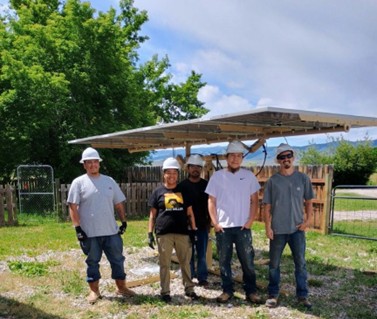
To expand their services to include weatherization, EWR is partnering with the Eastern Shoshone Housing Authority. EWR applied to a Climate Smart Communities Initiative grant which would enable ESHA to hire two-part time staff and prove the concept by funding the weatherization of an estimated 5 low-income homes. They will aim to reduce energy bills through appliance upgrades and weatherization. This work will continue to improve the quality of life across the Wind River Community by bringing energy savings to those who most need them, creating trade education, and creating employment opportunities in a growth sector for Tribal citizens. Tribal citizens could be trained to conduct energy efficiency and weatherization audits, which are valuable workforce development skills that can lead to employment opportunities.
From the time they were established to now, EWR hasn’t been afraid to ask for help. They created connections with phenomenal organizations, and some were able to provide technical assistance that was instrumental to EWR. Levi Purdum shared everyone that he would like to thank for their support: